Collagen has taken center stage in the skin health world, and with good reason. It provides the structural framework that keeps our skin firm and resilient. But like with anything related to our health, there’s always more to the story.
While collagen can help the skin feel more firm, it’s not as helpful with increasing skin elasticity. Here’s where elastin enters the picture. Comprehensive skin health depends on the partnership between collagen and elastin, not simply collagen alone.
If your goal is achieving optimal skin elasticity and strength, then read on to learn why elastin should be a part of your skincare priorities.
What is Elastin and Why is it Critical for Skin Elasticity?
Elastin, by its very name, is an elastic structural protein found in connective tissue throughout the body, including the skin, lungs, and blood vessels.1 Elastin fibers allow tissues to stretch and yet retain their shape and function.
Along with collagen, this allows for proper skin strength as well as skin elasticity. When these compounds start to break down, that’s when we start to see the visible signs of aging.
Once elastin is damaged or lost, skin becomes less able to “bounce back,” contributing to sagging and wrinkles, even if collagen levels are normal. Elastin benefits the skin by working with collagen to help slow down this unfortunate part of the aging process.
How Collagen and Elastin Work Together in the Skin
Think of collagen as acting like the scaffolding of the skin, and elastin as the flexible fibers woven through it. They don’t and can’t work in isolation. They actually form what we call the “extracellular matrix” which supports the overall health of our skin.2
Simply Put:
- Collagen fibers provide strength and firmness
- Elastin helps prevent the loss of skin elasticity
One way we see their powers combined is in wound healing. Research has shown that when skin is undergoing repair, both elastin and collagen come to the rescue, the former to pull the skin together and keep it supple, and the latter to promote firmness and structure. It’s a unique partnership, and the often overlooked role of elastin is essential.3
What Happens to Elastin as We Age?
Unlike collagen, which our bodies continue to make as we age (albeit at a slower rate), elastin production drops off significantly after adolescence.4
While we often can retain elastin levels for many years, the effects of diet, stress and the environment can take its toll.
As we age, elastin fibers can eventually:4
- Fragment and stiffen
- Become less organized
- Breakdown due to inflammation and UV exposure
Research suggests that one of the biggest hits to elastin and skin elasticity is the sun. UV radiation is one of the most common ways our skin can break down.5 Chronic low-grade inflammation, poor diet and oxidative stress can worsen this as well.
The result is dull, sagging, lifeless skin. But there may be a way to help.
Can You Restore Skin Elasticity with Supplements?
This is the big question. While aging is inevitable, there may be steps we can take to restore our skin’s youthful vitality. Research hints that targeted nutrition and specific supplements could improve the extracellular matrix of the skin.
One well-known supplement is collagen peptides. These have been shown to:7,8
- Improve skin hydration
- Increase skin firmness
- Reduce wrinkle production
Even though collagen is still king in the supplement world, don’t forget about adding an elastin supplement. While research is still limited, one small study found that elastin use:9
- Significantly improved skin elasticity
- Retained skin firmness
- Lessened wrinkling of the skin
In addition, key anti-inflammatory nutrients, such as vitamin C and Omega 3 fatty acids are critical as well. This is why an overall healthy diet pairs so well with targeted supplementation.
It comes down to is this:
- Yes, supplements can help, but you need to consider the whole package when it comes to restoring skin’s firmness and youthfulness.
- Combining all the needed structural proteins along with a healthy diet and select nutrients are likely more beneficial than a one-sided approach.
Why Collagen + Elastin Powders Offer More Complete Skin Support
We now know that collagen and elastin working together is the best approach for optimal skin. They both serve different but complementary roles, so combining them makes obvious sense.
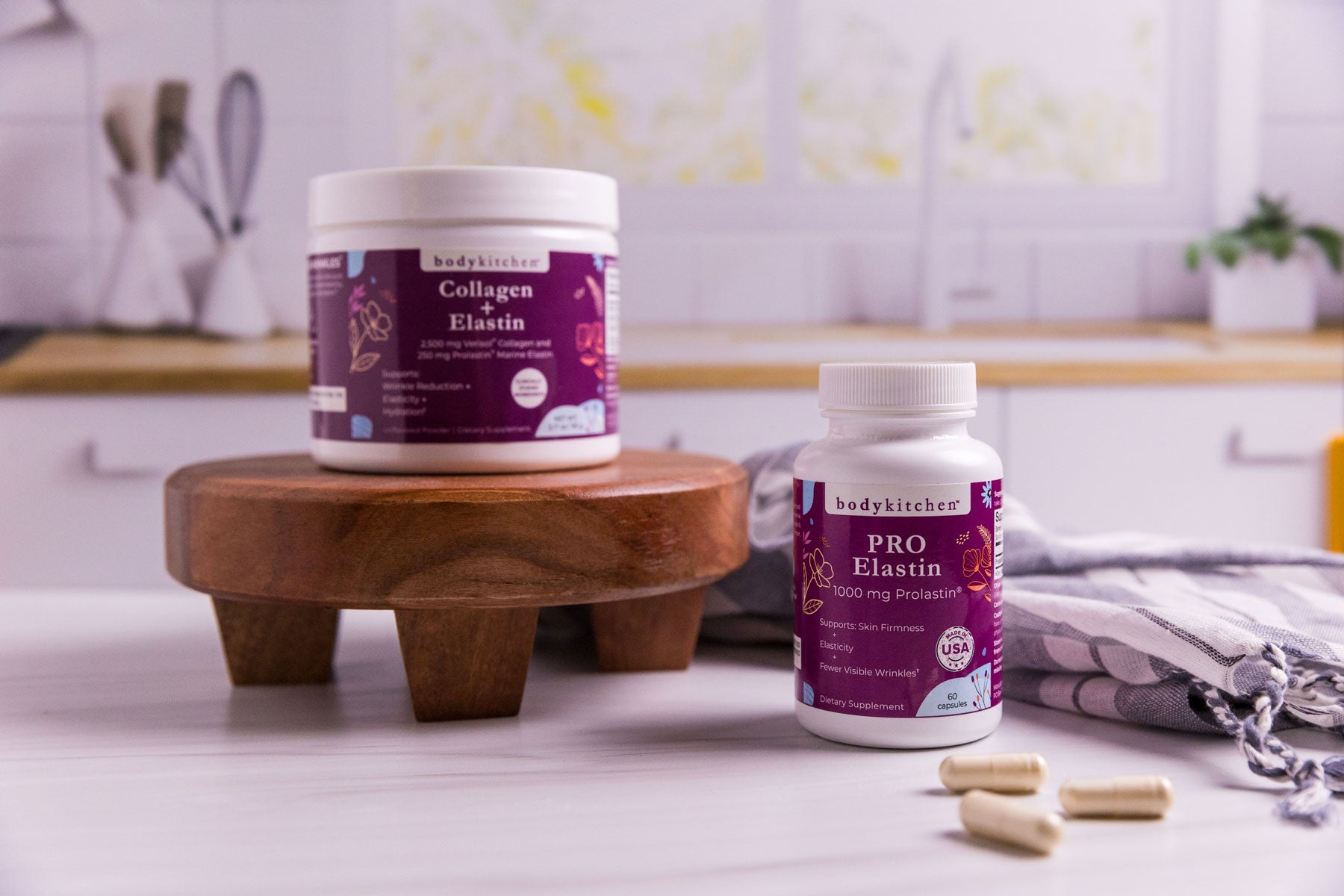
This is exactly why Body Kitchen combines a high-quality, hydrolyzed collagen powder along with a marine-based elastin powder to maximize both skin firmness and flexibility.
Body Kitchen’s Collagen + Elastin Powder is like a two for one, offering not only convenience but all the best skin-supportive ingredients in one package.
And for those already using a collagen powder, consider adding this product to your lineup to enhance what you are already doing. Collagen alone can certainly offer benefits, but adding elastin may be the missing piece to achieving lasting and noticeable results.
The Bottom Line
Collagen is essential for skin health – but it’s only half the story. Healthy, radiant skin depends on a dynamic matrix where collagen provides the structure and elastin provides the flexibility.
As both elastin and collagen naturally decline with age, research suggests that adding supplemental support may help. But the key is providing our skin with all the tools it needs to fight aging and prevent loss of skin elasticity.
Adding Body Kitchen’s Collagen + Elastin powder can be one simple way to get you part of the way there. By offering both high-quality collagen and elastin supplement powders, along with a few other skin-building ingredients, you can then focus on loving your skin in all the other ways that a supplement can never replicate – good nutrition, gentle movement, and self care.
It’s time to tell collagen to share the spotlight - in a nice way – with elastin.
Frequently Asked Questions
Why is collagen alone not enough for skin elasticity?
What does elastin do for the skin?
Does elastin decrease with age?
Can supplements help improve skin elasticity?
Who should take collagen and elastin together?
References:
- https://pubmed.ncbi.nlm.nih.gov/36979509/
- https://pubmed.ncbi.nlm.nih.gov/33605520/
- https://pubmed.ncbi.nlm.nih.gov/38483134/
- https://pubmed.ncbi.nlm.nih.gov/33896108/
- https://pubmed.ncbi.nlm.nih.gov/34195612/
- https://pubmed.ncbi.nlm.nih.gov/38217034/
- https://pubmed.ncbi.nlm.nih.gov/37432180/
- https://pubmed.ncbi.nlm.nih.gov/40826844/
- https://pmc.ncbi.nlm.nih.gov/articles/PMC9827338/