It’s time to leave cholesterol obsession in the rearview. Looking at the big picture is the better way forward. When you expand your focus from rigid ‘eat this, not that’ food rules, you invite more meaningful ways to be heart smart every day.
A heart-healthy diet is about more than avoiding saturated fat or cutting salt. You should feel empowered, not discouraged. Taking a holistic approach creates more opportunity to nourish the entire cardiovascular system—from organ to arteries, capillaries to veins. And this includes sealing nutritional gaps.
Folate, also known as vitamin B9, is one nutrient your heart wants filled. As with many micronutrients, folate takes a behind-the-scenes role, but it’s equally as vital to cardiovascular health and risk reduction as fiber and good fats. And when it comes to supporting smooth blood flow and healthy circulation, folate stands out.
Cardiovascular Health Is Only as Strong as Your Arteries
This vital system is responsible for keeping your body warm, pumped with oxygen, and free from toxins. And your arteries stand at the front line. These powerful, muscular blood vessels carry oxygenated blood from your heart and circulate it through smaller vessels to every cell in your body, keeping tissues nourished and functioning properly.
Healthy arteries rely on adequate folate levels to help maintain and strengthen their complex, tube-like structures, and to help repair damage. It’s a big job—one that suffers when folate levels dip below healthy levels.
Folate Supports Healthy, Flexible Arteries
Folate protects and repairs artery tissue, keeping structures strong and stable while maintaining elasticity. It works alongside vitamins B6 and B12 to fight one of the biggest threats to healthy artery function: homocysteine. When this amino acid accumulates along artery walls, it can damage the interior lining of blood vessels.* High homocysteine levels are also associated with calcification.*
Folate is needed to break down homocysteine, helping to reduce its harmful effect.* Additionally, folate fights oxidative stress, helping the endothelial lining work more efficiently for better blood flow.* This water-soluble vitamin also promotes healthy cell division and repair throughout the body, and supports production of oxygen-transporting red blood cells for energy and vitality.
Folate May Help Reduce Certain CV Risks
Low blood levels of folate have been linked to a higher risk of cardiovascular events. In a large UK study of over 115,000 participants, each incremental increase in daily folate intake was associated with a 5% lower total CV risk.*
In addition, a review of multiple independent studies published in the Journal of the American Heart Association found that daily folate supplementation was associated with a 10% reduction in brain-related CV risk.*
The Heart’s “Sweet Spot” for Folate
Studies reveal that folate works best within an optimal range.* For most healthy adults, the recommended daily allowance (RDA) of folate is 400 mcg.* Women who are pregnant or planning to become pregnant need 600 mcg daily, while those who are nursing should aim for 500 mcg daily.*
Women, in particular, may benefit from maintaining healthy folate levels throughout life. Research published in JAMA Cardiology reported that women’s blood vessels may age faster than men’s, which can lead to signs of heart health strain, such as blood pressure, as early as your 30s.*
Folate-Rich Foods
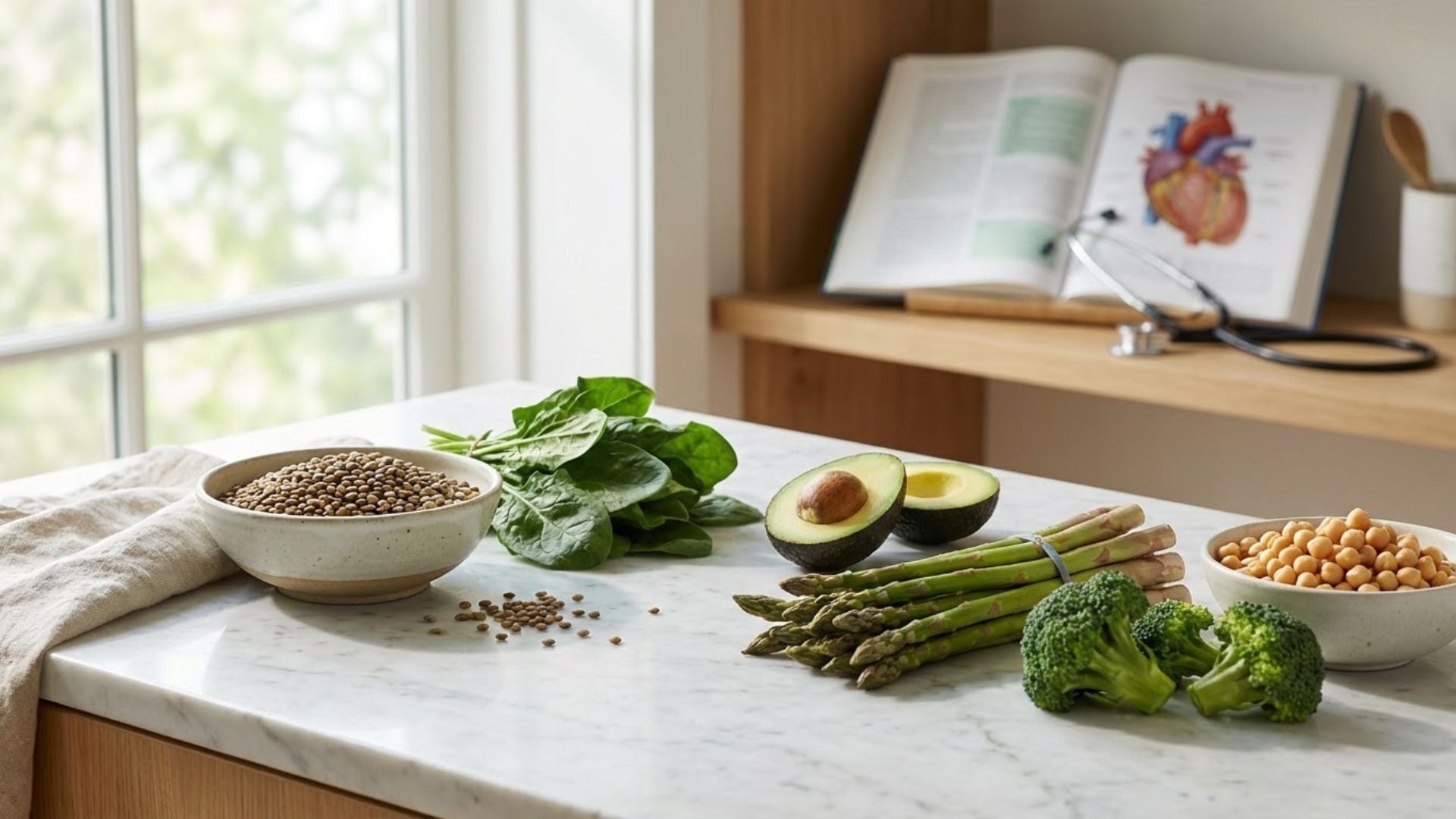
Cardiologists recommend a heart-healthy diet rich in folate. And when it comes to naturally high sources of folate, legumes reign supreme. These energy-dense seeds store high levels of folate needed for plant germination and cell division.
Legumes include lentils, beans, chickpeas, soybeans, peas, and peanuts. As you can see, it doesn’t take much to reach your daily value of folate:*
- 1 cup of cooked lentils = 90% of DV
- 1 cup of cooked soybeans = 50% of DV
- 1 cup of cooked kidney beans = 33% of DV
Eating greens is another excellent way to get your daily servings of folate. Leafy greens such as spinach and romaine lettuce, avocado, asparagus, Brussels sprouts, and broccoli are full of folate.*
Filling the Folate Gap with Supplements
Folic acid is the synthetic, stable form of folate used in dietary supplements and fortified foods, such as bread, cereal, and pasta. Your body breaks down folic acid into methylfolate before it can absorb and use it.
If you’re seeking a high-quality folate supplement that’s pre-converted and “ready to use,” look for Optifolin+ on the label. This optimized folate ingredient outperforms folic acid in bioavailability and absorption.*
With or Without Food?
For 100% absorption, an empty stomach is best.* That’s because there are no other macro- or micronutrients competing for absorption in the intestines. But if you have a sensitive stomach and prefer taking supplements with food, that’s okay, too. Bioavailability drops to about 85%—still highly effective and a good absorption rate.
February is American Heart Month. Honor the organ that connects and protects you with a heart-centered, science-backed solution.